Friday, November 30, 2012

What’s Next for Kik, One of the Original Mobile Messaging Hotshots


What’s Next for Kik, One of the Original Mobile Messaging Hotshots

Mobile messaging apps — WhatsApp, KakaoTalk, Line, WeChat, Voxer, Kik, etc — are in an interesting spot. They are some of the largest, most-used and best-loved apps in the world. They dominate their various countries and regions. But it’s not necessarily clear how they evolve and become long-lasting businesses. Are they social networks? Alternatives to mobile carriers? Or what?
Kik Messenger was early in this category, launching in late 2010 as the first app that mined users’ address books to find friends when they sign up (before that was more closely regulated).

After explosive growth as a cross-platform alternative to the popular BlackBerry chat app BBM — it got its first million users in 15 days — Kik lost a step when it was blocked and sued by Research In Motion. (That was particularly crushing given Kik founder and CEO Ted Livingston had interned at RIM and stayed in touch with the company as he dropped out of college to found his start-up.)
Livingston said this week that his app has not been standing still. Kik still signs up 100,000 new users per day, for a total of 30 million registered users.
Even after the lawsuit, Kik managed to close $8 million in Series A funding from RRE Ventures, Spark Capital and Union Square Ventures — and $4.3 million since then in bridge funding from the same investors as it has paid its legal bills and plotted its next move.
But the company has not added any new features in the past year except for speed and infrastructure improvements across its various free native apps.
Today, Kik is finally adding features, through a new design that tries to allow users to pick and choose what new stuff they want to add without cluttering up the core Kik experience of fast text messaging.
The idea, said Livingston, is to avoid the fate of applications that add feature after feature and “pivot” upon their core idea to the point that users have no idea why they’re useful.
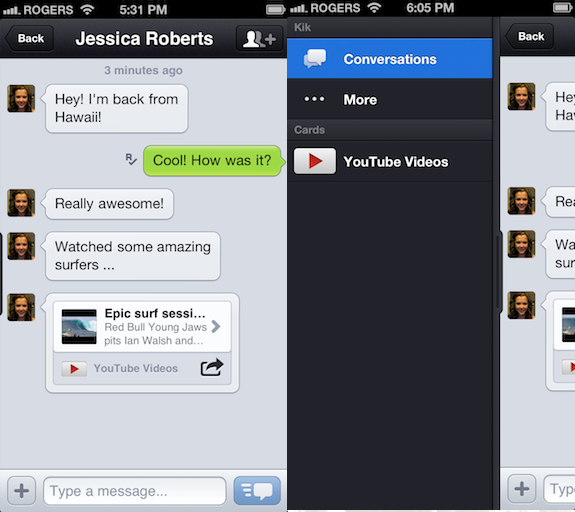
Kik’s concept is essentially a highly controlled app platform that it calls Cards. Users can opt to add the apps — for instance, a YouTube viewing interface or a sketch pad — to their Kik account. If they don’t add the apps, they can stick with good old messaging. When minimized, the Cards are just a tiny line of pixels along the left side of the app that can be swiped out like a drawer.
The Cards are all built in HTML5 so they are easily transferrable across all of Kik’s native apps.
Livingston is particularly proud of this architecture. “We know we’ll be immediately copied,” he bragged. But he feels that his team’s work in building tools and libraries around the HTML5 code to create the Cards is a defensible advantage for the company.
Unlike other social media sites’ app platforms, Kik Cards won’t be open to outside developers. In fact, the company plans for Cards to be its monetization strategy. Livingston said Kik will charge brands and other companies to make and feature custom Cards.
One-to-one messaging is a vastly underestimated form of social sharing, Livingston contended. “We think we can build the most viral network in the world for sharing content.”

Thursday, November 29, 2012

Apparently Students- MVP

Hey to all,
We've decided to answer the needs of the parental studential community at the Technion by creating an online informative & integrative platform that’s easy to use. The idea is to form a community for the parents at the Technion, where they can share tips, advice, interact and help each other. We've established a Facebook group which basically will be managed by its members. It already includes:
-          Useful links regarding pregnant/parental students’ rights in academic institutions
-          2 Bulletin boards for searching/offering babysitter services
-          An "events" tab, for example: communal carts strolling or Play dates
Our next MVP steps would be to extend the page contents with more helpful interaction options like selling/exchanging baby equipment, and to increase the number of members in the group.

Our Facebook link:


We appreciate your feedback!
Thank you.


project application google sites vs wix- Team 4

Initially, we began our website application via google sites. However, after quite some research on this topic, we're leaning towards using wix (software toolset).
 It seems to be geared to a younger, fresher crowd- great appearance and very user friendly. It's in flash player which is better because you get to customize everything, inlcuding backgrounds, size of pages etc. This sort of freedom is relatively limited via google sites, with their more rigid framework.  
 http://www.wix.com/about/us

Easy Paycheck-MVP

Hey all,
Easy Paycheck – MVP
Goal:  help young workers to understand better their paycheck sheet.
What we already have:
-          Home page
§  - “On the news” page which brings interesting and simple articles that talk
about paycheck, salaries, pension funds, study funds and etc.
§  “Calculators” : links to online calculators that can help you know how much Tax you have to pay or how much you have to discharge for Social Security.
§  “Finance advising” : information regarding where to invest your money wisely.
-          Paycheck:
§  Paycheck examples: different popular paychecks among the Technion students (Elbit, Refael, Intel and etc.)
§  Explanations: when moving the crosser across the paycheck examples you get a “pop-up” explanation on each of its essential ingredients
-          Holydays:
§  Calendar: a Hebrew Calendar with all the Jewish holydays and which one are paid and which are not.
-          Contact us
§  We are interested to know what information the users are missing and we will love to add it.
What’s next?
-          Enlarging the “from the news” page and add more interesting topics
-          Add explanations and opinions in the “from the news” page.
-          Add a “finance dictionary for the simple people”
-          Add and adjust the Calculator in a way they will fit more to our target customers.
-          A function that links the popup small explanations in the “Paychecks” page to a more thorough explanation page.
WE WOULD LOVE TO HERE MORE IDEAS FROM THE CV COMMUNITY.
WE WILL DO OUR HELP TO PROVIDE THE OTHER PROJECT WITH CREATIVE AND HELPFULL
ADVISE IN RETURN.

Wednesday, November 28, 2012

Make it transparent – in a see-through world, it doesn’t pay to be opaque

Transparency is perceived as a scary, radical and impractical way of providing information about your business because you have to tell the truth about the good and the bad aspects in the same manner. However, an increasing number of companies is trying to adopt the new model of corporate behavior and thus is moving transparency into the mainstream.

In this era of technology, communication via Internet allows consumers and activists to find positive as well as negative information about a company, start discussions and ask tough questions straightforwardly. These people want to participate in the company’s decision-making processes. Building transparency makes them perceive the company as trustworthy, credible and accountable. There is less to criticize when a company announces its mistakes itself and reports the areas where it failed in an honest way. Therefore, the risk of getting a bad reputation does not increase. On the contrary, critics can be turned into collaborators, helping the company solve its problems and achieve its business goals.

If consumers and key stakeholders are not involved in the improvement process, dishonest acts can cause long-term reputation damages. In our reputation economy, every single brand will be affected if the industry is suffering from scandals. Nevertheless, the company can profit from a crisis by meeting activists and appropriate institutions, and possibly correct their misperceptions.

On the whole, becoming transparent is comparable to the product lifecycle: Transparency is not a state of being but an endless process. It includes observing the industry, activists, NGOs, changes in society’s values, business expectations as well as the competition’s action. You have to benefit from the “first-mover advantage” by reacting as quickly as possible to signs of movement. As in production, there is a learning curve for the evolution of the societal issue the company is facing. Eventually, with the help of stakeholders and society, the company moves its business into the desired direction. During this cycle, as the company offers information in a more transparent way, the demands for transparency increase, too.

Patagonia
Probably no other company has spent more time calculating and mapping its greatest negative effects than Patagonia, the pioneering outdoor apparel and gear producer. The notion that companies should operate with maximum transparency is written into the “Our Values” statement that the deep ecologist Jerry Mander penned for Patagonia long ago. Because of those values, Patagonia was one of the first U.S companies to take a hard, uncompromising look at its activities’ environmental toll. In order to do that properly, the company relied on another one of its core values - to ask tough questions, delve into deviously difficult problems, and push for solutions. And so it was that in 1991, the Ventura, California - based company set about casting a cold eye on the environmental footprint of the four major fibers that go into its wares: wool, polyester, nylon, and cotton. They knew even before the study that petroleum-based synthetics were enviro-villains, but the big surprise was that the creation of so-called “natural” products made from cotton and wool was every bit as bad.
Patagonia founder Yvon Chouinard dispatched a team of environmental-impact scouts to bird-dog the company’s wool and cotton supply chains all the way back to their respective sources. The team soon found that wool soaks up chemicals at each stage of its processing, and conventionally grown cotton is even worse. For an outfit whose fundamental raison d’être is to “inspire and implement solutions to the environmental crisis”, chemically grown cotton was a poison pill that could potentially weaken the brand and afflict the company’s core principles.
Instead of worming its way around the cotton conundrum, Patagonia followed its injunction to think through the problem, find a just principle, and apply it. Thanks to the founder’s prodding, Patagonia’s board of directors voted to dump the conventional cotton and switch to 100% organic. To adopt “good cotton”, Patagonia would have to convert farmers and clothing manufacturers to the good-cotton cause. In order to achieve this goal, Patagonia took the following steps:
- open-sourced the dark side of its performance. The company made the results of its environmental impact study accessible to anyone who asked.
-made it real. The organic agriculture activist Will Allen led a busload of Patagonia’s apparel-manufacturing reps on a tour of cotton farms.
-made it personal. Chouinard wrote a stirring essay in which he mapped out the moral case for going organic.
-took responsibility. The company held a three-day conference where they showed an introductory video underlining Patagonia’s flinty resolve to assume responsibility for its own actions.
After two years, Patagonia finally switched to all-organic cotton, which sparked a decline in sales at first, but eventually the company right-sized itself by demonstrating that it’s better to pay a little more upfront than to postpone even higher payments for the hidden environmental costs of chemical cotton. Along the way, Patagonia built a better-quality line of clothing, stayed aligned with its principles, and influenced far bigger companies, such as Levi Strauss and Wal-Mart to follow its lead.
Patagonia’s most ambitious experiment with radical transparency grew out of its frustration with conventional corporate responsibility reporting. The effort to gather all of the GRI’s compliance data and assemble it into a standardized format proved an enormous time sink. The lesson learned for Patagonia from the experience was the desire to share in a way that felt true to Patagonia’s tell-it-like-it-is culture. Given that the Web was fueling consumers’ desire to learn more, Patagonia decided that it would use its website to tell more.
In the spring of 2007, Patagonia’s head honcho (coll.) for environmental initiatives, with the help of a few people, created an interactive microsite called “The Footprint Chronicles,” which launched in the fall of that year. The site cuts through the great swaths of data that so often overwhelm conventional CR reporting by homing in on the environmental impacts that matter the most: miles traveled, waste produced, carbon dioxide emitted, and energy consumed. Whereas  companies too often slink past the bad news in their CR reporting, Chronicles confronts it head on, through two boxes appropriately titled “The Good” and “The Bad”. In the building of the Footprint Chronicles were followed three design principles:  
1) Success breeds that powerful motivation called fear: The effort to launch the site got a lot of adrenaline when the April 2007 issue of Fortune featured Chouinard on its cover. Although pleased with the recognition, staffers were queasy over the possibility that the celebrity treatment could prove to be a contrarian indicator. In a sense, Patagonia’s fear of the article repercussions overcame its fear of transparency.
2) Perfection is not required: There are questions for which there are no easy answers, and only by understanding it they could begin to enlist consumers help in crafting solutions
3) Write tight: There is no space for explanations and justifications. Context is clutter; excuses are excluded. What remains are simply the unadorned, unvarnished facts of each product’s environmental impact.

Timberland:
With roughly six thousand employees working across the United States, Europe and Asia, and 2008 revenues of $1.36 billion, Timberland is far bigger than Patagonia and certainly more mainstream.
In its pursuit of radical transparency, Timberland is almost as fearless and arguably as innovative as Patagonia.
Timberland has moved from issuing unhurried annual CSR reports to fast-forward, quarterly updates of key performance indicators. It has cut through the complexity of those lengthy reports by developing a "Green Index" tag, modeled on a nutrition label, which gives consumers a quick take on how some products are rated in terms of their impact on the environment. Also it has moved from "corporate statement" to "stakeholder engagement" by launching quarterly phone dialogues with CEO Jeffrey Swartz, in which callers can zero in on a critical issues of the moment, such as eco-labeling and sustainable sources. According to Swartz, our world is in an environmental crisis, and Timberland is part of the problem, that's why it has to fix things now. Transparency is about urgency!
In the 1990s , Timberland watched protesters denounce two giants in its industry, Nike and Gap, for sweatshop conditions in their suppliers' factories. Timberland used similar sourcing processes as other brands, which made them just as vulnerable. According to Beth Holzman, Timberland's manager of CSR strategy and reporting: "That realization really started a lot of conversations about what we could publicly divulge".
Transparency depends on data; a company has to audit its social and environmental performance, in order to know its impact on society and environment; for example, greenhouse gas emissions. To calculate the amount of carbon dioxide released in creating its boots, Timberland chased down both its greenhouse-gas emissions and those of its suppliers. Timberland found out that 90 percent of Timberland's greenhouse gas output comes from cows and from converting their hide to leather. (Grass munching cows emit staggering amounts of methane, which converts to CO2 in the atmosphere). That revelation led Swartz to understand that they need to find ways to use less leather and still produce a boot that sells.
Timberland's tool for change is the Green Index tag. It is a label that assesses, on a scale of 0 (best) to 10 (worst), each pair of shoes' impact on climate change, as well as the resources and chemicals used to make them.

Novo Nordisk
Novo Nordisk is a Danish health care company that supplies the majority of the world’s insulin. Novo Nordisk understands that if the company admits its mistakes, activists are less likely to criticize it. In that way, the company uses critics to improve its social and environmental record. Being transparent about ongoing agendas of social issues, the company turns critics into collaborators and benefits from their contribution.This includes, for example, bioethics, such as  animal testing and gene research.
During the 90s, the Animal Welfare Society protested against living conditions of laboratory animals; the situation led to a long standing collaboration and world-leading standards for housing laboratory animals humanely.
Despite the fact that some workers at Novo Nordisk didn’t agree with transparency implementation, the company managed to overcome the issues. It even won society’s approval by engaging the shareholders on controversial issues such as animal testing. This conversation extended to the highest levels of organization ; this made sure the final decision came with the senior management’s approval and thus carried actual weight.
That’s why, for the purpose of being up to date with ongoing social issues, Novo Nordisk employs a powerful tool called the “Learning Curve” to track the evolution of a societal issue that might threaten the company, as it’s critical to react in the early stages.
Talking about 90s experience of Novo Nordisk, they understood that the activists were right after their own investigation discovered that housing condition for laboratory animals were indeed inadequate. That’s why meeting with key people in the Animal Welfare movement helped them to explore ways to forge a partnership, so as to develop improved standards for housing animals and a set of principles for their use and testing. Later, these standards were incorporated into the Council of Europe’s revised guidelines on the protection of animals used in research, which led to a joint presentation by a drug-producing company and an animal-welfare group at a pharmaceutical industry conference.

MVPs evaluation graph - based on the community feedback  

Inline image 1

urban agriculture - green community

hi all, 
here is a link to our mvp , this site is based on the WordPress platform
on the main page you can see recent posts regarding urban agriculture and related topics , there are YouTube videos links to maps and articles 
 on the right hand side you'll see a menu that helps you navigate through the posts 
on the top of the page there are categories with texts  ,guides etc. about a variety of topics the difference here is that these articles don't disappear into storage like recent posts, the texts are fixed and can be read without conducting a search on the blog page 

please give us many comments so  that we can improve 

Tuesday, November 27, 2012

What's on your mind?

Please post any thoughts, ideas to our community and course.
Lesson Learned

Share your team's Lessons Learned experiences resulting from your Lean Startup project here.  

Sunday, November 25, 2012

MVP test 1

We (Team 5) would appreciate it if you could respond to the following test:
hi all,
  we will appreciate your assistance in filling the survey in the link attached if you are apart of the reserve duty .community in the Technion
thanks in advance- Team 1

Hi everyone! I want to apologize, because I’m going to be missing the next two lessons. Due to my boyfriend's arrival from Chile. I hope you can understand me and pay attention to the make-up I will do soon. 

Thank you!

Thursday, November 22, 2012

Rewarder

Chen Ben Shimon suggests that each group will adopt a different group. The adopting group will advise and accompany its adopted group throughout the project. In addition, every two weeks, good efforts will be rewarded. This will result not only caring and a more pleasant environment, but also will produce optimal tools to help us and our community.
Here students will request help from the SV community regarding developing their MVPs
Here students will provide feedbacks on each MVP: each group should write a post which describes their MVP idea, and the rest of the class will write a comment (feedback) about that idea.

Monday, November 19, 2012

Hi,
I missed an hour of class today in order to attend the protest that was organized by the Technion's students in the purpose of showing support and solidarity with Israel's southern residents and the defense forces.
This was very important for me, as many of my friends were called for reserved duty (some of them leaving their wives and young children at home).
I usually get called for reserved duty as well- though now, due to my pregnancy-all I can do is send my support from home, hoping this will all come to an end as soon as possible,
and everyone will return home safely.
Noga.

Thursday, November 15, 2012


When you find a much better value-for-money provider, you can say goodbye to your annoying service provider with little effort.  Here is how


Netek    ברוכים הבאים לאתר NeTek.co.il

נתק הוא השירות הראשון מסוגו בישראל שמאפשר
לך לשלוח הודעות ניתוק לספקי תקשורת, על פי חוק  בשלושה צעדיםפשוטים


 Problem & pain    

Customers are held hostages by organizations that continue to bill them and not letting them leave.               


       Solutions    

A site that makes it easy to terminate any contract with a service provider.                     

Wednesday, November 14, 2012

Not a company,but a cummunity-Tools


The rewarded -software tool that gives the power of rewarding to the employees.
How does it work?
Each quarter every  employee gets a share of the company's revenue (approximately 1000$ per person) that he can distribute  as bonus between all other employees but himself according to the employees contribution to the company.
The advantages:
The advantages of the system are it takes the "power" of deciding who gets the bonus money from the management  ,that usually keeps the money to their close circles. Furthermore  this system can stick out contributing employees that usually are not recognized by management because they are modest,  quiet and don't like to be noted and so forth
The disadvantage is that people can take advantage of the system and choose to give the reward to the friends and so forth. Because of the annual performance review at  the company  and sometimes not objectively review and can cause some interpersonal conflicts.

The love machine-
Linden Lab chairmen and founder create a tool to improve the workplace environment and to reduce fear and bad "KARMA" from employees, he called it "The Love Machine".
This tool is a web page that lets Linden's employees the option to send appreciation messages to colleagues. For an example, if you see that an employee did a good job in a subject that important to the your company, you click on "The Love Machine", write him a quick thank-you and send. Now he feels good, because your appreciation for his job, and you feel good because you spread your love. The idea is to spread appreciation and love into the corporate and give  the employees confident and self estimate, in the additional it makes people happy when they spread their own love.
At Linden corporate there are 300 workers that 25% of them use the "Love Machine", therefore, there are 300 massages in Linden's net every day and everybody  can see them flow, it makes good environment and collaboration at the company. This cumulative affect, washes away the cynicism and the insecurity that every day exists in most of the workplaces today, and give the employees feeling of appreciation. This tool, especially important this days, when most of the work is done on the internet and almost impossible to notice, therefore it's hard to get gratification. The "Love Machine" give  people the gratitude they need and empower them, which is a big advantage to the corporation.
Advantages:

1. It gives the people in the company the opportunity to spread their love

2. When people get gratitude on their job they get motivated.

3. This tool gives the chance to say thank-you to the employee that actually did the hard work.

4. It makes a good environment in the company

5. It can make good competition among employees

Disadvantages:
1. It can waste an important working time.

2. Workers can send love to their friend and not according the good job they  have done. 

3. It can make workers jealous of each other and be over-competitive.

How does Linden Lab make money?

  The profit model of Linden Lab is to sell/rent digital real estate in the "second life" world.

It is so powerful because they can create a boundless land ,and if there will be demand for the land they will keep selling it. second life actually has it's own economy.it has it 's own money that is magnet for currency speculators and real estate marketers. Second life money is easily cashed out to real world dollars.

Another tool of Linden Leb:

In it’s first year as a start-up ,instead of assigning engineers to work on specific project, Linden let them chose their work from a vast of database of tasks .that's how the "A&Os" got created."A&Os" is a reporting tool where the employees share the achievements and objectives with all other employees ,in the tool they mention what they have accomplished this week and what is their work for the upcoming week. The advantage of this tool is that the employees will arrange automatically in organic teams with shared intrests, that way the pressure to perform comes out not from the bosses, but from peers-a far more powerful group of motivators. This method had a rule that she will exsit only when the results are accountable.by creating this tool that everybody share there tasks, and by the transparently of the tool with comments of the employees  on other employees tasks Lindon yokes the collective wisdom into the entire organization.
hello
i was not present in this weeks assignment due to miluim duty, how do i make up for the lost session,

thank's in advance

Eyal Werner

Monday, November 12, 2012

Take the World's Best Courses, Online, For Free.


Coursera is a social entrepreneurship company that partners with the top universities in the world to offer courses online for anyone to take, for free. They envision a future where the top universities are educating not only thousands of students, but millions. Their technology enables the best professors to teach tens or hundreds of thousands of students.

You can take a variety of courses:
Introduction to Sustainability, Jonathan Tomkin

  • Model Thinking, Scott E. Page
  • Securing Digital Democracy, J. Alex Halderman
  • Modern & Contemporary American Poetry, Al Filreis
  • Even from our own A Brief History of Humankind, Dr. Yuval Noah Harari 
  • and many more...

Check them out: Click here

Good Guide


Good Guide is in business to provide authoritative information about the health, environmental and social performance of products and companies.
Their mission is to help consumers make purchasing decisions that reflect their preferences and values.Their belief is that better information can transform the marketplace: as more consumers buy better products, retailers and manufacturers face compelling incentives to make products that are safe, environmentally sustainable and produced using ethical sourcing of raw materials and labor.

Check them out: Click here